
Storm season in the Triangle: what to do when a tree falls on your house
By Alejandro Castro, Castro Tree Services · · 6 min read
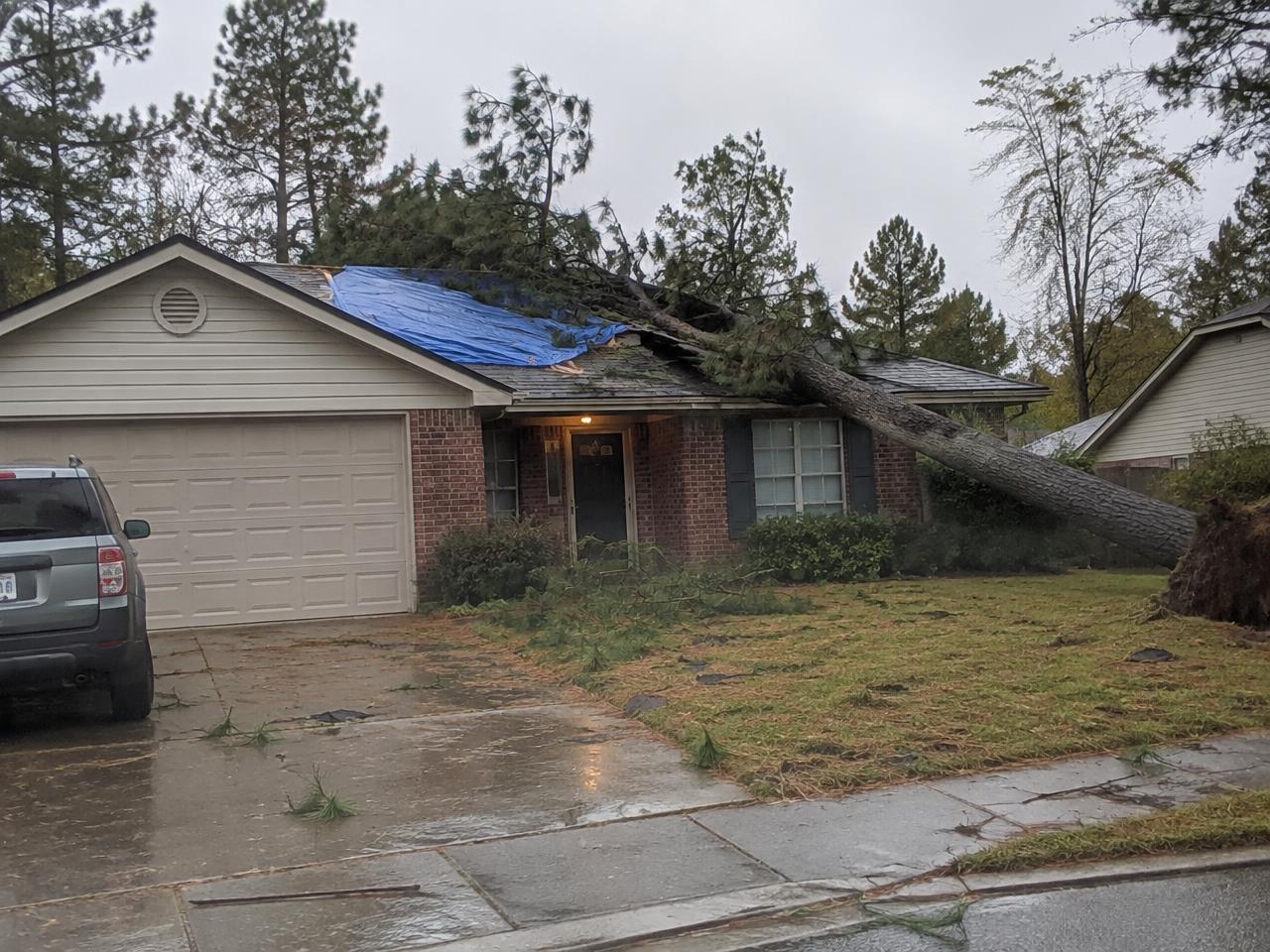
A tree through the roof is a bad hour. The steps below are the order we tell people on the phone, and doing them in this order protects both your family and your insurance claim.
If a tree is on your house right now, call (919) 264-2635 — for emergencies the phone is much faster than any form.
1. Get everyone out from under it
Leave the rooms the tree is resting on, including the floor below, and stay out of them. A tree that came to rest on a roof is not finished moving — trusses settle, and a limb under load can release with no warning.
If the structure is groaning, the ceiling is sagging, or you smell gas, get everyone outside and call 911.
2. Treat every wire as live
If any wire is down, touching the tree, or torn off the house, stay at least 30 feet away, keep children and pets inside, and call Duke Energy. Do not touch the tree, the fence it is on, or standing water near it.
No tree company can safely work a tree on primary lines until the utility clears it. That call has to come first, and any crew that tells you otherwise should not be on your property.
3. Shut off what needs shutting off
If water is coming in near fixtures or panels, kill power to the affected circuits at the breaker only if you can reach it safely and you are not standing in water. Turn the water off at the main if a line is broken. If you suspect gas, leave and call from outside.
4. Photograph everything before anyone moves it
This is the step people skip and regret. From safe positions, photograph the tree on the structure from several angles, the damage inside, the base and root plate of the tree, and any wet or damaged contents.
- Wide shots showing the whole tree and the house together.
- Close shots of the point of impact, inside and out.
- The base of the tree — carriers ask whether it was healthy.
- Every damaged room and item, before you move anything.
- Time-stamped video walking the exterior is useful too.
5. Call your insurance carrier early
Homeowner policies generally cover removal of a tree that has damaged a covered structure, plus the repairs, subject to your deductible. Trees that simply fell in the yard are often not covered, or only up to a small removal allowance.
Ask specifically what your policy allows for emergency mitigation, whether tarping is covered, and what documentation the adjuster wants. Never sign your claim over to a contractor, and be skeptical of crews that appear in the neighborhood within an hour of the storm.
6. Call a tree company, then a roofer — in that order
The tree comes off first, in controlled pieces, so the roof can be dried in and repaired. We take weight off the structure by rigging rather than dragging, then handle the wood and cleanup. You get photos and an itemized invoice for the adjuster.
Expect to wait if a regional ice or wind event hit the whole Triangle. Everyone calls at once, so we triage by danger: trees on houses and trees on wires before trees in yards. Tell us exactly what the tree is resting on and we can place you accurately.
Getting ahead of the next one
Most of the trees we cut off houses had a visible problem beforehand: a lifting root plate, a crack, a dead top, or a lean that had changed. Walk your yard after a heavy rain, look at the base of anything within falling distance of the house, and get the doubtful ones looked at on a calm week rather than a dark one.
We respond same day across Apex, Cary, Holly Springs, and Raleigh when a tree is on a structure. Call (919) 264-2635 and tell us what it is resting on.