
5 signs a tree in your yard is about to fall
By Alejandro Castro, Castro Tree Services · · 6 min read
After a storm we hear the same sentence constantly: it looked completely healthy. Usually it did, from the driveway. The signs that matter are at the base and in the top, and they are easy to see once you know what you are looking at.
Walk your yard after the next heavy rain and check these five things.
1. Soil heaving or cracking at the base
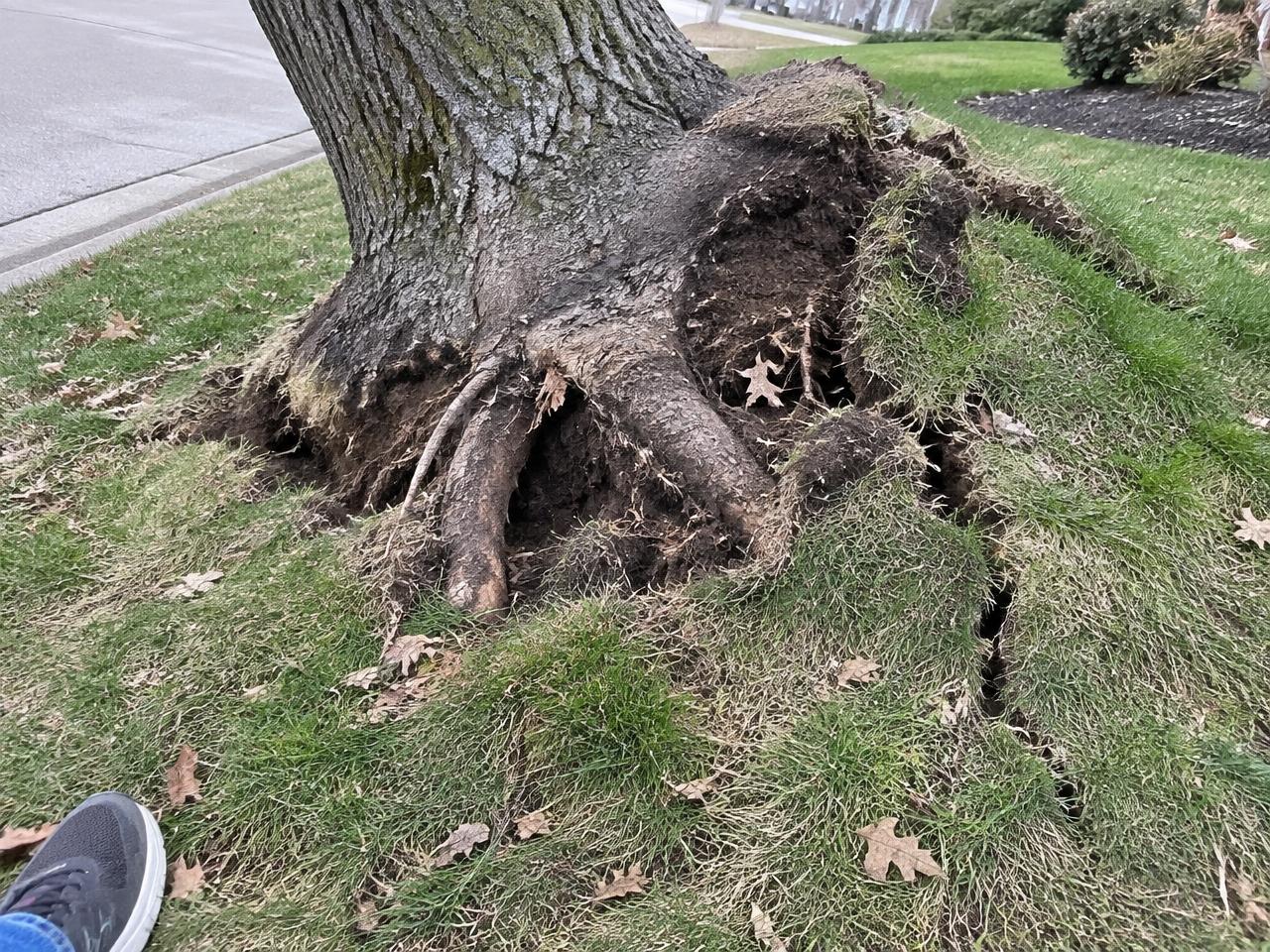
This is the most urgent sign there is. If the ground on one side of the trunk is mounded, cracked, or lifting, the root plate is already moving. A tree in that state can go over in an ordinary thunderstorm.
Look for a fresh gap between trunk and soil, exposed root undersides, or a crescent of lifted turf on the side opposite the lean. Found it? Keep people out from under the tree and call somebody today.
2. A crack, seam, or split in the trunk
A vertical seam running up the trunk, or a split where two main stems join, means the wood is already separating. Include the union between codominant stems — that narrow V shape with bark pinched between the stems is the classic failure point, and it is why Bradford pears come apart around twenty years old.
Cracks that open and close as the tree moves in wind are the serious kind.
3. Mushrooms or fungal brackets at the base
Shelf-like fungus on the lower trunk or the root flare is a decay organism fruiting, which means it has been eating the interior for a while. The canopy can look completely fine while the structural wood is gone.
Hollow sound when you knock the base, missing bark, or carpenter ants streaming out of a hole point the same direction.
4. Dead wood and a thinning top
Bare branches in the upper canopy while the rest leafs out is a tree in decline, working from the top down. In pines, watch for the needles going pale or rust-brown across a whole crown — a pine that browns out is dead and it will start dropping limbs quickly.
Deadwood is also the everyday risk. Most limbs that come through a roof were already dead before the storm.
5. A lean that changed
An old lean the tree grew into, with a thickened trunk on the low side, is generally stable. A lean that appeared or increased after a storm is not. The tell is reaction wood: if there is no swelling and no compensating growth on the lower side, that lean is new.
The quick homeowner checklist
- Walk a full circle around the trunk and look at the ground, not the canopy.
- Check the root flare for mounding, cracks, fungus, or missing bark.
- Look up and note bare branches, hanging limbs, and thin patches in the crown.
- Compare the lean against your house line — take a photo so you can compare next season.
- Note anything within falling distance: bedrooms, the driveway, the play set, the service wire.
- Photograph anything that concerns you. Photos are usually enough for us to tell you whether it needs action.
Which trees around here need the closest look
In Wake County, prioritize tall loblolly pines that lost their neighbors to development, mature water oaks in older Cary, Raleigh, and Garner neighborhoods, and any Bradford pear with a narrow trunk union. Those three account for most of the failures we get called out to.
If something on this list describes a tree of yours, send us a photo of the base and one of the whole tree. We will tell you straight whether it needs to come down now, later, or not at all.